


Children learn to survive BUT we should NOT call this resilience
Children learn to survive BUT we should NOT call this resilience https://thejaneevans.com/wp-content/themes/corpus/images/empty/thumbnail.jpg 150 150 Jane Evans https://secure.gravatar.com/avatar/1b06bd036211b82cdba19b095bacdad4?s=96&d=mm&r=g
I was on a flight from Serbia to Heathrow recently. Behind me in the security que was a Dad with 2 young children. A little boy of about 4, a girl of about 6 they had just been to visit a museum as part of their trip and were all tired. The Dad was teasing them about the security check, it was mildly amusing, I’m not sure what the children made of it.
He seemed a caring Dad doing his best; they got settled into their seats. The children had activity books, the Dad took to his phone and book alternatively. The little boy struggled on and off as he was clearly exhausted and a bit out of sorts being trapped in his seat on a 3 hour journey. Then he knocked his drink over. Dad lost it at that point, “you stupid boy” and other accusations followed. Then the child smiled. I couldn’t see it but I could hear how angry this made the parent. “Don’t you dare smile at me” he said through gritted teeth. Eventually the child cried.
A Parent Missing the Mark?
Children like fun and funny words if they are part of the joke and mischief. However, many of them can’t follow the complexities of sarcasm at their expense. They can just sense the negativity of it, which is confusing and will put them on high alert or they will zone out.
Children are easily fatigued and will lose co-ordination and cry easily and become irritable and unable to settle. They need adults who recognise this and keep things simple for, and with them.
Trapped on a plane with an adult carer full of rage the little boy’s survival system switched AUTOMATICALLY into the only mode available to him. He couldn’t fight or flee from the angry words, sense of threat and face so he smiled to try and win his Dad over. This is one of the ‘inbuilt’ survival mechanisms we all have. In the past the little boy may have survived this way, it doesn’t mean he is resilient to the fear he feels in the moment.
Smiles are an In-built Survival Mechanism
Our systems are primed to prioritise survival or the human race would have died out long ago. There are 4 main survival systems which are AUTOMATIC. We flick in to the one which has given us the best survival outcome.
- Social engagement – smile, befriend, try to win over –often seen as mocking or manipulation
- Fighting or fleeing – strong urges to lash out or run – seen as ‘being angry’ or running off to ‘seek attention’
- Freeze – stillness, no reaction – seen as being defiant and non-responsive, not caring and rudeness
- Dissociation – too much freeze can lead to shut down, zoning out as a way nature allows us to not be present and therefore avoid pain and fear – seen as defiance, non-cooperation, difficult behaviour
SURVIVAL not RESILIENCE
Eventually Dad calmed down, later he offered the little boy his lap to snuggle in to sleep. The child climbed in but could not settle. It may be that this little boy grows up using social engagement, being the smiley, pleasing one to navigate his way through life. Keep others happy, especially if they scare you. This is SURVIVAL it is not RESILIENCE.
Resilience develops beautifully within unconditional care-giving relationships (these don’t need to be perfect ones) where a child can make a mistake, test things out, be really emotional and they are met with compassionate holding and co-operative learning. They can then internalise resilience which is wonderful for every aspect of their daily life and their onward journey to great health and resilience.
It’s NEVER too late to change how we interact with children. The brain is able to form different connections until we die so can learn to respond and react differently if the environment and those in it changes.
To find out more and to work with Jane:
M: 07455281247
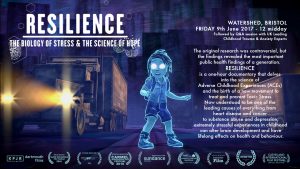
Join Jane for the Bristol Premiere of the profoundly moving and thought-provoking documentary Resilience followed by a Q&A session.
Created by John Redford of KPJR Films and featuring Dr. Nadine Burke, Resilience shows evidence of the clear links between early adversity for children and how to create experiences that build resilience as they move forward.
Tickets are very limited so don’t miss out!

Leave a Reply